


Searching for stem cell therapy in Dallas often starts with a practical concern: pain is interfering with your life, and you want to understand your options before committing to another treatment. Perhaps walking has become uncomfortable, an injury keeps interrupting exercise, or you have questions after a surgical consultation.
The challenge is that “stem cell therapy” does not describe one standardized procedure. Clinics may use the phrase for different materials, preparation methods, and treatments. Understanding exactly what is being offered matters more than the label.
This guide focuses on the questions that help you evaluate a proposal: what the product contains, how its use is regulated, what research supports it, and how it compares with established care. For broader background, see our guide to regenerative medicine in Dallas.
1. What Does “Stem Cell Therapy” Actually Mean?
Stem cells can renew themselves and develop into certain specialized cells. Their capabilities differ by cell type and source. In orthopedic marketing, however, the phrase “stem cell therapy” may be used loosely enough that it tells you very little about the actual procedure.

A useful consultation should replace that broad phrase with a specific description. Is the clinician proposing a blood-derived preparation, concentrated bone marrow, processed fat tissue, or a donor-derived product? Does the material contain living cells, and how is that established?
Two terms are particularly helpful:
- Autologous: Material comes from your own body.
- Allogeneic: Material comes from another person.
Neither term establishes that a treatment will work for your condition. They describe the source, which is only one part of evaluating a procedure.
The American Academy of Orthopaedic Surgeons (AAOS) notes that evidence supporting stem cell treatments for orthopedic conditions remains limited. It also cautions that there is little evidence that injected cells survive long enough to multiply and directly rebuild healthy tissue. Claims about replacing worn cartilage therefore require careful scrutiny.
Ask the clinician to write down the exact treatment name. That gives you something concrete to research, discuss with your regular physician, and compare with another opinion.
2. Regenerative Treatment Options You May Encounter in Dallas
The options discussed during a regenerative medicine consultation are not interchangeable. Dallas Stem Cell Center’s existing information describes BMAC and other supportive modalities, but availability and suitability should be confirmed during an individual evaluation.

Platelet-Rich Plasma
Platelet-rich plasma, or PRP, is prepared from a blood sample. Processing concentrates platelets, which contain proteins involved in healing responses. PRP is a blood-derived treatment, not a stem cell injection.
AAOS describes evidence supporting PRP for some tendon conditions and mild to moderate knee osteoarthritis, while noting that effectiveness depends on the condition and preparation. Results for one problem should not be applied automatically to another.
If PRP is proposed, ask why it fits your diagnosis, what evidence supports that use, and how the clinician will judge whether it helped.
Bone Marrow Aspirate Concentrate
Bone marrow aspirate concentrate, or BMAC, is prepared from bone marrow collected from the patient, commonly from the pelvic bone. It contains a mixture of cells and other components. It should not be described as a purified or standardized dose of stem cells.
Our BMAC therapy in Dallas guide provides background on this treatment category. When discussing a specific procedure, request details about collection, processing, injection location, and the evidence supporting that application.
Donor-Derived Products and Exosomes
Products marketed as umbilical cord, Wharton’s jelly, or amniotic products require their own evaluation. A tissue-source label does not demonstrate effectiveness or establish approval for the proposed use.
Exosomes are another distinct category. They are small particles released by cells, not stem cells themselves. The FDA states that there are no FDA-approved exosome products.
| Treatment category | What the name describes | Main question to ask |
|---|---|---|
| PRP | A platelet-concentrated blood preparation | What supports its use for my diagnosis? |
| BMAC | Concentrated material from bone marrow | What does this preparation contain, and why recommend it? |
| Donor-derived product | Material obtained from another person | What is the exact product and its regulatory status? |
| Exosome product | Cell-released particles | What authorizes this product’s use in my situation? |
3. Is Stem Cell Therapy FDA-Approved for Joint Pain?
The FDA’s patient guidance states that the regenerative medicine products discussed in its warning have not been approved for orthopedic conditions such as osteoarthritis, tendonitis, disc disease, or knee and hip pain. Do not interpret a clinic’s use of “regenerative” or “stem cell” as confirmation of FDA approval.
Approval must be checked for the exact product and indication, meaning the condition and patient group for which it is approved.

An Approval for Another Disease Does Not Establish Approval for Arthritis
Some cell therapies have legitimate, specific FDA-approved uses. For example, Ryoncil is approved for steroid-refractory acute graft-versus-host disease in pediatric patients aged two months and older. That approval does not establish an arthritis indication for Ryoncil or validate unrelated injections offered under a similar scientific description.
This distinction matters when an advertisement references a breakthrough without explaining whether it concerns the treatment you would receive.
Registration Is Different From Approval
A business registered with the FDA has not necessarily received approval for its treatment. Similarly, appearing on ClinicalTrials.gov does not establish that a product is approved or legally marketed. The FDA specifically warns patients about these misunderstandings.
Request the product name and the documentation supporting any approval claim. If the answer concerns a processing device, ask separately about the injected product and proposed treatment.
Your Own Cells Do Not Automatically Remove Regulatory Requirements
FDA guidance addresses how human cell and tissue products are processed and used. Concepts such as minimal manipulation and homologous use affect the regulatory analysis. Homologous use concerns whether the material performs the same basic function in the recipient as in its original tissue.
Patients should not have to interpret these rules alone. Ask the provider to explain the applicable pathway clearly. “It comes from your body” is not a complete answer to a regulatory question.
4. What Does the Research Say About Results?
Research should answer a specific question about a specific treatment. A study of PRP for knee osteoarthritis cannot establish that a donor-derived product works for back pain. Even treatments with similar names can differ in composition and preparation.
AAOS describes encouraging findings for some orthobiologic applications but notes that rigorous evidence is lacking for many orthopedic uses.
Improvement Does Not Necessarily Show That One Treatment Is Better
A randomized trial published in Nature Medicine compared several cell-based injections, including BMAC, with corticosteroid injection for knee osteoarthritis. At one year, the cell-based treatments did not demonstrate superiority over the corticosteroid comparison for the study’s primary pain outcomes.
That result does not mean nobody improved. It illustrates why reports of improvement alone do not establish that a more complex treatment provides additional benefit.
Pain Relief and Tissue Regrowth Are Different Outcomes
When a provider says a treatment “works,” ask what that means. Less pain, better walking tolerance, reduced medication use, and cartilage repair are different claims requiring different evidence.
For example, imagine that your goal is to walk through the grocery store comfortably. A meaningful change in walking ability would matter to you. It would still not establish that an injection rebuilt the joint.
Ask How Closely the Evidence Matches Your Situation
Useful questions include:
- Did participants have my diagnosis and a similar degree of disease?
- Was the same product or preparation used?
- What was the comparison treatment?
- Were benefits meaningful to patients, and how long were they measured?
- Were complications and people who did not improve reported?
A responsible discussion can include uncertainty. You should be able to understand both the reason for considering treatment and the limits of that reasoning.
5. Start With the Diagnosis Behind Your Symptoms
Before choosing a procedure, clarify what is being treated. “Knee pain” identifies a location. It does not establish the underlying problem or determine which option makes sense.
For knee arthritis, evaluation may include a symptom history, physical examination, and appropriate imaging. Findings need to be considered together rather than treating an imaging phrase as the entire diagnosis.

Joint Pain and Structural Injuries Need Different Conversations
If you are comparing knee arthritis and meniscus tears, use that information to prepare questions for an examination. Ask which findings explain your symptoms and whether more than one problem is present.
Someone discussing knee arthritis treatment may have different goals from someone being assessed after a sudden injury. A shared symptom does not justify an identical injection plan.
Back Pain Deserves Its Own Assessment
Do not assume that a study involving knee injections applies to a spine procedure. If your concern is spine pain, ask the clinician to identify the proposed target, explain the diagnosis, and provide evidence relevant to that location and procedure.
A Condition Listing Is Not Evidence of Treatment Effectiveness
Our conditions we see page can help you identify topics to raise during a consultation. Inclusion on a clinic website does not establish that a regenerative product is approved or proven for that condition.
For neurological, autoimmune, or other systemic illnesses, involve the specialist managing your established care. Ask how any proposed intervention would fit with that care before making changes.
6. Who Should Consider a Consultation?
A consultation can be useful when symptoms persist, the diagnosis is unclear, or you want to compare a proposed procedure with other options. Booking an evaluation should not commit you to treatment.
Prepare a short account of what matters most:
- Which activities have become difficult?
- What treatments have you tried, and what happened?
- What would count as a worthwhile improvement?
- What recovery limitations would be difficult to manage?
- How much uncertainty and out-of-pocket expense are you comfortable accepting?
These questions help turn a general request for “regeneration” into a practical discussion.
For instance, imagine two people with similar imaging results. One wants to sleep more comfortably and manage household tasks. The other hopes to return to demanding competitive activity. Their priorities differ, so the discussion of acceptable benefit, limitations, and next steps should reflect those differences.
Bring relevant imaging reports, prior procedure records, a medication list, and details of rehabilitation. Ask the clinician to explain why you are or are not a reasonable candidate for the proposed option.
“I would not recommend this treatment for you” can be a useful outcome of a consultation. It should come with an explanation and a discussion of alternatives.
7. When Standard Care or Surgery May Be More Appropriate
Regenerative treatment should be compared with the full range of reasonable options. For knee osteoarthritis, established management may include therapeutic exercise, physical therapy, weight management where appropriate, assistive devices, and medication chosen around the patient’s health risks. Surgery may be considered when nonsurgical care no longer adequately addresses pain and disability.

Discuss what has actually been tried before describing standard care as unsuccessful. What exercises were prescribed? Was the program practical enough to follow? Did it address your specific limitations? What helped temporarily, and what caused side effects?
Our non-surgical regenerative medicine guide offers additional context for discussing nonsurgical options. The next step should still be based on the diagnosis and evidence for each proposal.
If surgery has been recommended, ask the surgeon what problem the operation would address and what the consequences of postponing it might be. A second opinion can help you compare choices without assuming that either surgery or an injection is automatically preferable.
Choosing an operation when it is appropriate is not a failure. Choosing continued conservative care can also be reasonable. The decision should reflect expected benefit, risk, function, and your priorities.
8. What Risks Should You Discuss Before Treatment?
An injection or tissue collection procedure can involve infection, bleeding, pain, or reactions. The risk discussion should match the actual product, collection method, and injection location. Using your own material does not eliminate procedural risks.
The FDA has also reported serious harms associated with unapproved regenerative products, including infections, unwanted immune reactions, tumor formation, and blindness. These reports involve different products and routes of administration; they should not be treated as a complication rate for every orthopedic injection.

Ask what complications the clinician considers relevant to your proposed procedure, how they are managed, and whom you should contact if problems occur.
Before agreeing to treatment, request written instructions covering medication management, expected symptoms, warning signs, and follow-up. If instructions conflict with advice from another treating physician, have the clinicians resolve the difference. Do not independently stop a prescribed medication to prepare for a procedure.
Also consider the risk of spending time and money on a treatment that does not help. Ask: “If I do not improve, when will we reassess the diagnosis and discuss a different plan?”
9. What Does Treatment Cost, and Will Insurance Cover It?
There is no reliable single price for “stem cell therapy in Dallas” because the term can refer to substantially different procedures. AAOS notes that orthobiologic costs vary and insurance coverage may be limited. Verify the exact treatment and diagnosis with your insurer before proceeding.

Request a written, itemized estimate. Clarify whether it includes:
- Initial evaluation and any imaging.
- Tissue collection, processing, and injection.
- Facility, anesthesia, or other procedure fees.
- Follow-up visits and rehabilitation.
- Additional injections or optional services.
Ask which items are essential to the proposed plan and which are optional. If several treatments are bundled together, request a separate explanation of the purpose, evidence, and cost of each component.
Do not assume that financing, reimbursement paperwork, or an insurance billing code means coverage is guaranteed. Ask your insurer about authorization requirements and your expected responsibility.
If considering financing options, review the total repayment amount, interest, cancellation terms, and obligations if treatment is postponed. A manageable monthly payment does not answer whether a procedure is medically worthwhile.
The cost conversation should include an uncomfortable but necessary possibility: what would the financial impact be if you received little or no benefit?
10. How to Compare a Stem Cell Clinic in Dallas
Compare how clearly clinics answer your questions. A polished website or persuasive consultation should not replace a precise treatment explanation.

Verify Who Is Responsible for Your Care
Identify the clinician who will assess you, perform the procedure, and manage follow-up. Ask about relevant training and experience with your diagnosis and the proposed technique. The clinic’s About Us page can be a starting point for questions about the care team.
Request a Written Treatment Rationale
A useful proposal should identify your diagnosis, the exact treatment, its intended purpose, supporting evidence, material risks, alternatives, and total expected cost. Ask whether the rationale would change if you chose not to proceed immediately.
Be Cautious With Broad Claims
Promises to cure unrelated diseases, guarantee cartilage regrowth, or permanently prevent surgery deserve scrutiny. Ask for evidence supporting the exact statement being made.
Patient stories may help describe someone’s experience, but they cannot show how likely you are to achieve the same result. Ask what happens for people who do not improve and whether the clinic measures outcomes consistently.
If Research Participation Is Proposed, Clarify the Details
Request the study name, protocol, investigator, consent information, applicable FDA authorization, and ethics oversight. Ask about participant costs, alternatives to participation, and how adverse events are handled.
You should have time to review the information and discuss it with another physician. A discount deadline is not a medical reason to decide quickly.
11. Agree on Recovery and Follow-Up Before the Procedure
A treatment plan should explain what happens after the appointment. Avoid relying on a general promise of “no downtime” or a fixed recovery schedule that ignores the procedure and your daily responsibilities.
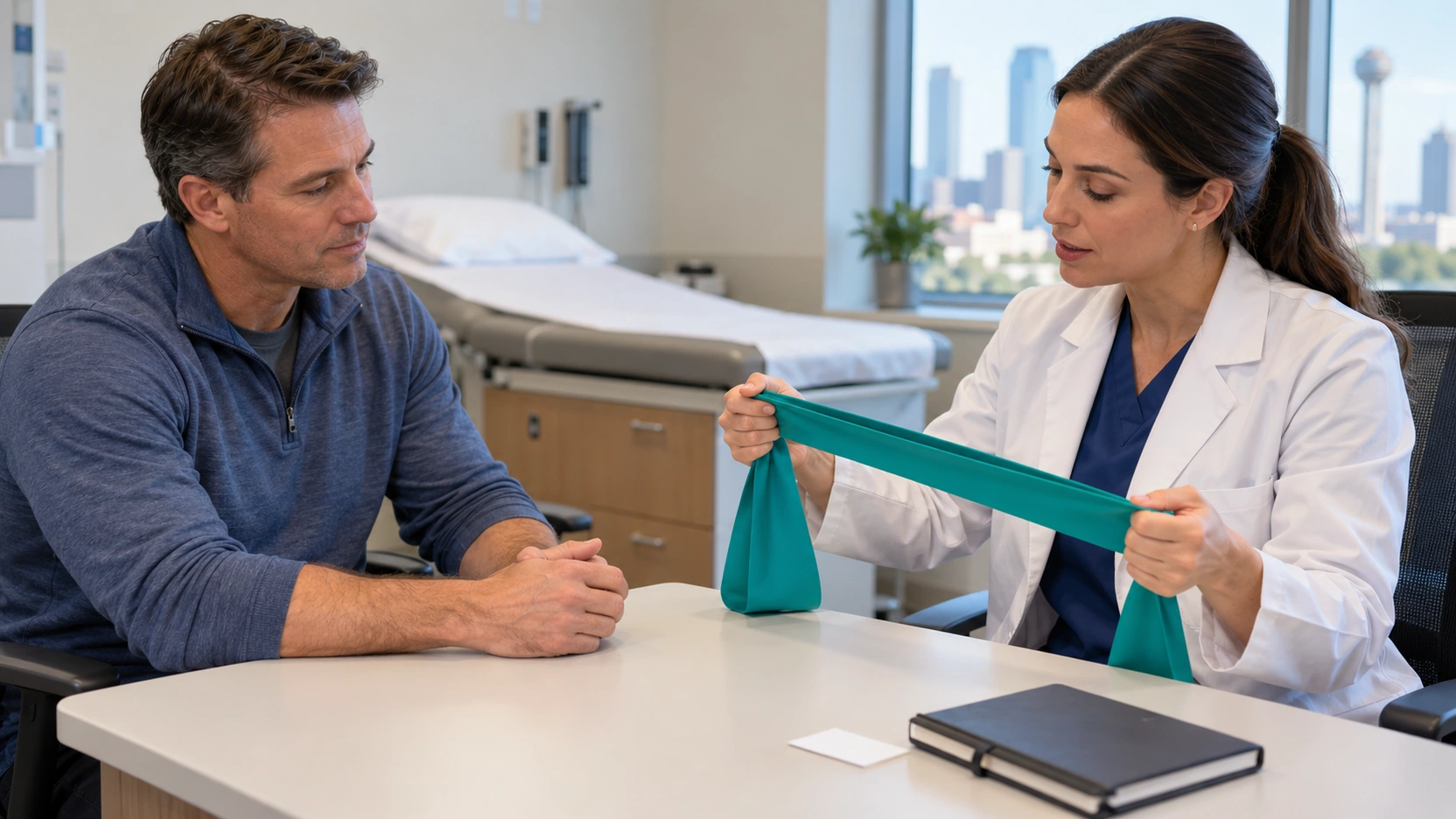
Ask for instructions about work, driving, exercise, physical therapy, wound care where relevant, and whom to call with concerns. Clarify which restrictions apply to you and what findings would allow activities to progress.
Agree on how progress will be measured. Choose practical goals such as walking a familiar route, using stairs, sleeping with fewer interruptions, or completing a work task. Record your starting point so follow-up conversations have a clear reference.
Ask when the first review will occur, when lack of improvement would prompt reassessment, and what would justify another procedure. Repeating treatment should have a reason that you understand.
For Dallas-area patients, planning may also involve transportation, time away from work, and help at home. Discuss these details before payment or scheduling so the care plan fits your circumstances.
12. Tell Us About Your Condition
If you are considering stem cell therapy in Dallas, start by explaining the problem you want help with. Include how long symptoms have affected you, what activities are limited, which treatments you have tried, and any questions raised by previous evaluations.
Ask for a discussion that connects the diagnosis with the proposed treatment and addresses evidence, FDA status, risks, costs, alternatives, and follow-up. The goal is to understand your choices well enough to make a considered decision.
Tell us about your condition to contact Dallas Stem Cell Center and ask about an evaluation. A consultation can help clarify the next step, including when further testing, rehabilitation, established treatment, or another specialist’s opinion deserves priority.
This article provides general educational information and does not determine whether a particular treatment is appropriate for you.